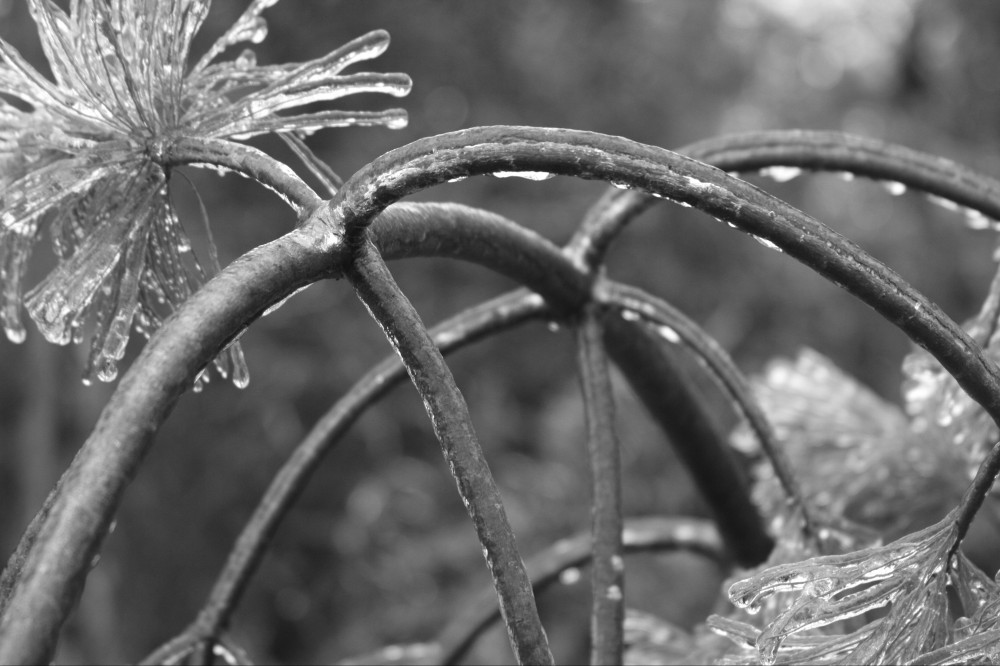
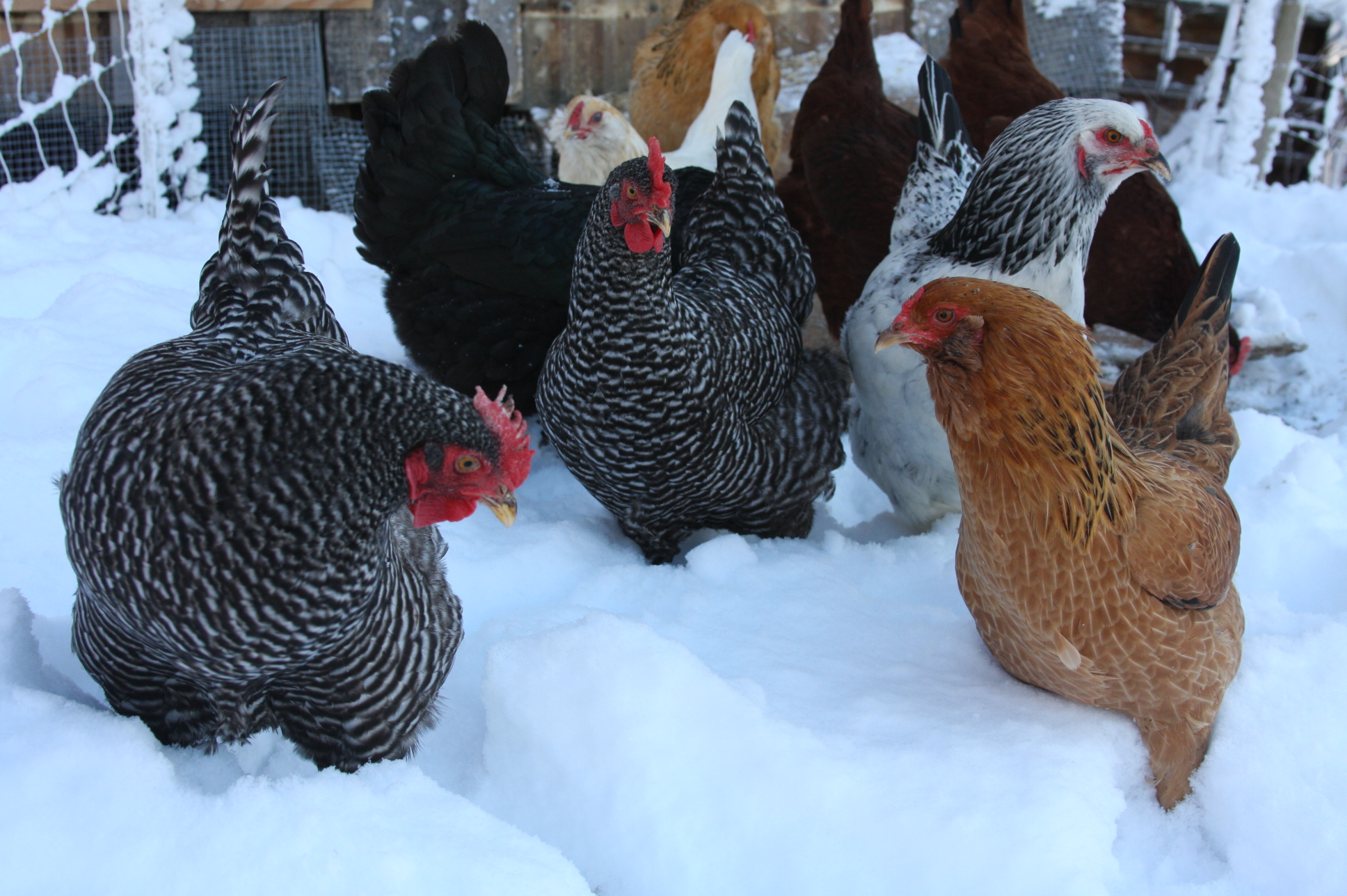
While I revel in the beauty of winter sunrises and ice- and snow-covered landscapes, this time of year can be tough, my warm weather roots showing clearly by mid-January. For my chickens too, it is a challenging time of year. The “girls” don’t seem to like winter much more than I do, but are much better at enduring and adapting. Winter is a time for staying inside, staying warm, molting and an egg production break, all part of their winter hiatus; a time of renewal and rest.
Winter signifies a drop off in egg production, but thankfully this year, I got through the Thanksgiving cooking frenzy time before egg laying mostly ceased and oh horror, I had to buy eggs from the grocery store. It doesn’t come easy any more, placing those store bought eggs in the cart. Now, with that addition comes the thoughts of production chicken lives: caged, crowded, sunlight and outside time free. Even many of the “free-range and organic” chickens have lives not much different than their non-free range, non-organic cousins. Living with chickens has given me such a clear vision of what chickens, left to be chickens, do: stay outside, roll in the dirt, flap and fly short distances, grub around for bugs and worms, chase each other with food in their beaks, perch on anything that is perchable, and eat any greens they can find. That paused moment of putting “store-bought eggs” in the cart also comes with the hope that the girls will start laying again, soon. I miss the goodness of those rich, fresh eggs, not to mention the knowledge of the good, healthy living my chickens have. Recently, I had the wonderful surprise of finding 3 eggs in the laying box after a few weeks without. It was akin to finding gold: a very merry Christmas present from the girls.
Let me digress a moment to discuss naming chickens. When I started with chickens, I was drawn in by the chicken catalogs, wanting one of every breed and bigger orders were cheaper and better for shipping. I ended up ordering so many that naming was not an option. The exception was that one rooster they snuck into my order who was absolutely gorgeous, but overly aggressive and prone to sneak attacks from behind. He earned the name “son-of-a-bitch”, among other less savory names. I don’t pet my chickens, play with them or have them sit in my lap as some folks do. It might actually be handy at times to have them be more pet-like. When I do have reason to catch one, it ain’t easy. It must be highly amusing to watch me scramble after these wily hens.
The steady dwindling of my flock to the current number of 5 due to predator losses has bread a familiarity and a somewhat inevitable deeper emotional connection and attachment. Despite my original goal of being a very pragmatic, no-nonsense chicken wrangler, I am, in truth, a big softy, so they have affectionately become known as “the girls”. There is a whole lot of endearment in that moniker. And yes, I do talk to them, sometimes in the chicken talk that I’ve learned over the past several years. Chickens, it turns out, are quite chatty and I do chicken talk quite well. Sometimes I stand up on my deck and yell down, “good morning girls” and they come running to the fence in their chicken yard, squawking their chicken-squawk. Heart-warming? You bet!

During molting

After – Shiny new feathers!
This cold, wintry time of year is also when the girls lose their feathers, which doesn’t seem like the best time to lose your outer wear. It’s the time of year when you can see the shape beneath those beautiful feathers and the resemblance to grocery store meat-section chickens becomes more apparent. Pre-chicken life, I had no idea that chickens lost all their feathers every 18 months or so and grew a fresh, new feather dress. Part of the reason for egg cessation each year is this molting time. Those hens are putting every bit of energy they have into creating a completely new outfit. It’s good to feed them extra protein during this time. If you don’t know that chickens molt regularly, it can be utterly alarming to see one of these poor creatures, tail-feathers gone, bald patches, mangy looking feather-coat. Not to mention the momentary heart palpitations experienced when walking into the coop and seeing feathers EVERYWHERE. That, all too often, has meant that some critter got inside, mayhem ensued, and one of the flock was absconded. Upon finding the feather-flurry, it has sometimes taken me a few heart-racing moments to realize it is just another molting hen.
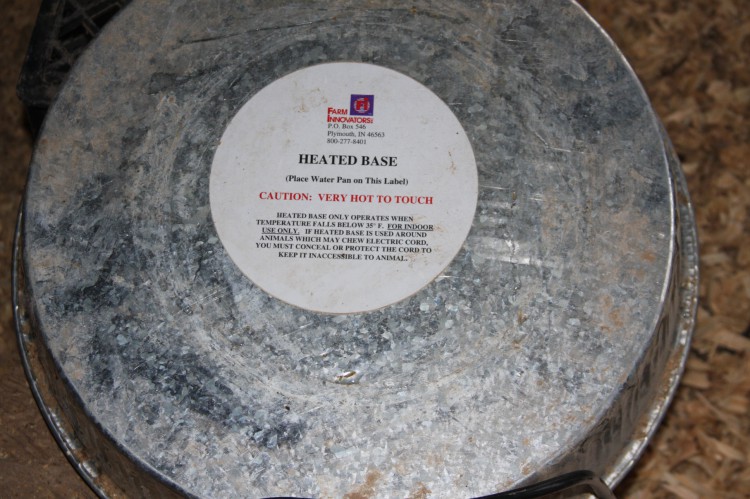
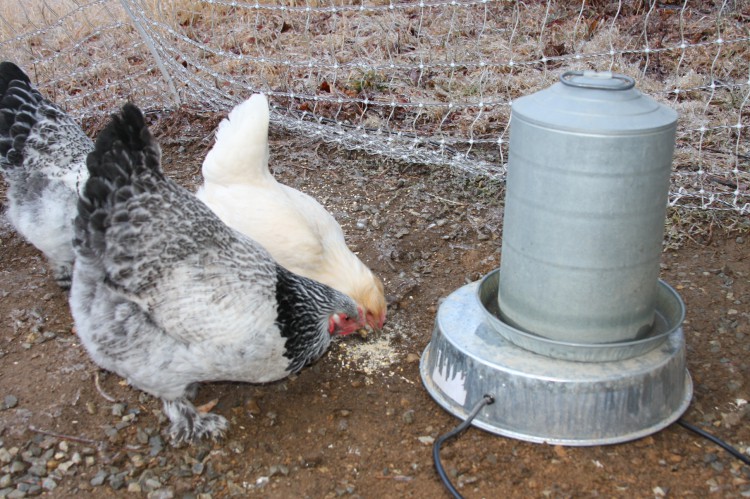
While molting and no eggs are part of winter challenges, so is keeping fresh, unfrozen water for them. This year, I invested in a chicken water heater. This utilitarian, non-descript, galvanized circular contraption has been one of the best things I’ve purchased recently. The first chicken year, I did buy one of the plastic waterers with a heated base. Filled it with water, took it down to the chickens, turned it over to set down and it came apart. Gallons of water everywhere! Tried again, more carefully this time and…. same result. Returned waterer, thinking it was defective, got a new one, brought it home and…..same result. ARGGHH. Returned waterer #2 with a vow to never buy such a crappy waterer….ever….again.
I looked around for other heater options and found one, but perhaps because of my do-it-the-hard-way first nature, along with my inability to justify the cost or the use of electricity, I just didn’t do it. This third chicken winter, months into the daily hauling water routine, something snapped and I thought that’s it! I hopped online and that water heater base was on its way. When I went to pick it up at my rural post office (same place my chicks arrived 2 1/2 years ago), the box clearly showed the contents and the postmistress seeing my excitement, looked at me knowingly. We chatted about the travails of hauling water, sometimes twice daily, to keep various farm animals watered and the techniques for managing winter water. Love my rural post office!
This thing has been a revelation. One of the best purchases I have made. Some women go crazy for clothes, shoes and handbags (OK, I do like shoes too), but I am undone by a galvanized chicken water heater. Forget the chocolates and flowers: the way to my heart appears to be through a chicken water heater. I love this thing! Its internal thermostat is set to come on only when the temperature drops below freezing, which assuages my frugal electricity-miser mode, learned from 11 years living off the grid. Now my girls have water at all times. No more hauling water down the hill every morning, sometimes twice a day when temperatures were really cold. A small device, which by-god works well, that is paying dividends in time and energy saved, while also benefiting my flock. Have I said how much I love this thing? I LOVE MY CHICKEN WATER HEATER!
So, here we are in late-January. My loyal egg customers and I are eagerly anticipating the return to regular egg laying. On occasion I get the wonderful surprise of an egg or two. The araucana has been the only one to lay recently and has gifted me with 3 perfect, pretty blue eggs – which I ate immediately. No more daily water hauling, hurrah. All the girls have now gone through the molting process and my, don’t they look resplendent and warm in their fine new feather dresses. They occasionally come outside but for the most part they are just trying to stay fed, stay warm and let their bodies rest and renew in preparation for the coming of spring. Perhaps we all should take a cue from their playbook and enjoy this winter time of rest and renewal and dream of spring, and green and fresh eggs!
 Life on Locust Ridge
Beautiful! Love this one!
Thank you John!